The 10 best photo spots in Madrid (2026)
From the Temple of Debod to El Retiro, an honest guide to the 10 best Madrid locations — when to go, what to avoid, how to pose, and tips from local photographers.
Madrid has no sea, but it gives you something few capitals have: light. High, clean, golden light that falls on stone façades, imperial gardens, and rooftops facing the mountains. There is no single icon to chase here — just a whole city to walk. Below, the 10 most recommended locations for a session in Madrid: for each one we share the best time, what to avoid, what charges admission, and a composition trick you only learn after many visits.
1. Temple of Debod — Madrid most famous sunset
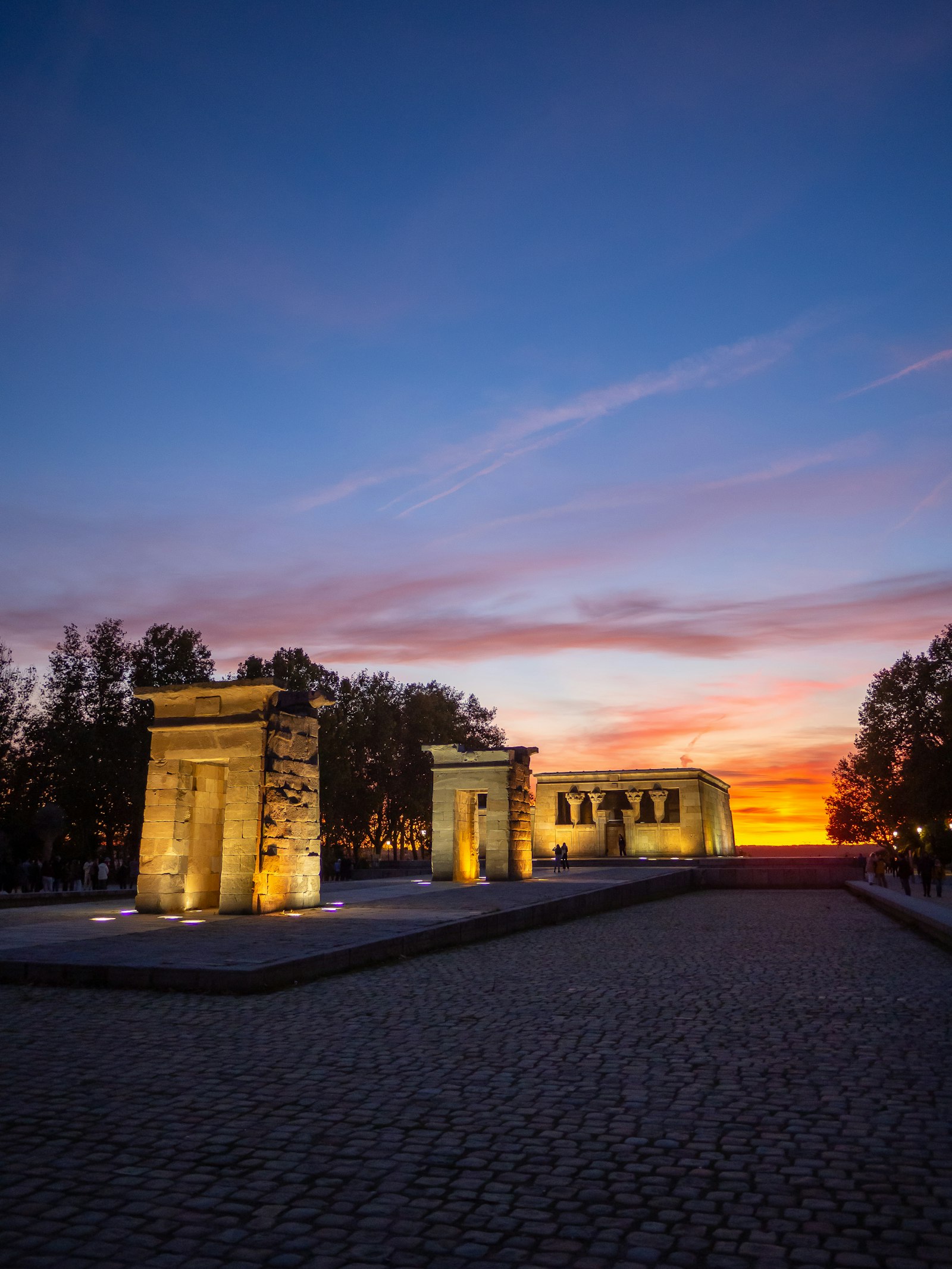
An authentic Egyptian temple, gifted to Spain and rebuilt on a hill with open western views. It is, without argument, the best spot in the city for sunset: the sky blazes behind the stone and the pond reflects the whole silhouette. Free and open-air.
The problem is that all of Madrid knows it. Arrive 45 minutes before sunset to grab a place on the north side of the pond, away from the main crowd. Avoid the weekend if you can — half the people come midweek.
Pro composition: crouch down until you almost touch the water and use the pond reflection as a symmetrical mirror. The couple is cut against the orange sky and the temple floats over its own image.
2. El Retiro Park — the imperial garden
Madrid great green lung hides three golden locations in one park: the Crystal Palace, the pond with its Alfonso XII monument, and the avenues of century-old trees. Free and huge, so you can chain very different backdrops in a single session.
Best time is right after opening (6:00 in summer, 7:00 in winter). The Crystal Palace is empty then and light pours through its glass walls, creating a greenhouse glow. By mid-morning the groups and the pond rowboats arrive and the magic is gone.
Local photographer trick: at the Crystal Palace, do not shoot head-on; stand at a diagonal so the sun enters through the side glass and draws geometric shadows on the floor. That pattern is what separates a tourist photo from an author photo.
3. Plaza de España and Gran Vía — the vertical city
Here Madrid turns into a metropolis: 1950s skyscrapers, the Cervantes monument, and the endless perspective of Gran Vía with its cinematic buildings. The heart of cinematic Madrid, perfect for an urban, elegant look.
Gran Vía is never empty, so forget about having it to yourself. The best light hits the Metrópolis building between 8:00 and 9:00, when the low sun lights it head-on and traffic is still thin. For rooftops, the Círculo de Bellas Artes terrace (paid entry, about €5) gives the most iconic aerial view.
Pro composition: on Gran Vía, use the crosswalks and traffic motion to your advantage. A slow shutter speed turns the cars into light streaks and keeps the subjects sharp and still in the middle of the chaos.
4. Royal Palace and Almudena Cathedral
Madrid most imposing monumental ensemble: the white façade of the Royal Palace, the Almudena dome, and Plaza de Oriente with its statues and gardens. Grandeur in the air, and the scale gives photos that look from another era.
Best light is early morning, when the sun comes from the east and lights the palace façade head-on from the Plaza de la Armería. For sunset, cross to the Temple of Debod or go down to the Sabatini Gardens, where the palace stands cut against the sky.
Local photographer trick: in Plaza de Oriente, place the couple between the statues of the Gothic kings and shoot from below. The stone figures frame the scene and give a theatrical, almost operatic feel.
5-6. Malasaña and Lavapiés — neighborhood Madrid
If you want color, character, and zero monument posing, these two neighborhoods are your place. Malasaña has painted façades, colored shutters, murals, and the legendary Plaza del Dos de Mayo. Lavapiés is even more bohemian: steep streets, street art, and a cultural mix that gives lively, real scenes.
Best time is the afternoon, between 17:00 and 19:00, when light bounces warm between the narrow façades. Avoid Sunday midday in Lavapiés because of the El Rastro market crowds — too many people and stalls everywhere.
Pro composition: find a mural wall as a saturated color background and dress the subjects in tones that contrast rather than match. A green mural with red clothing, or a blue one with beige, makes the person jump off the background.
7-8. Plaza Mayor and Plaza de Cibeles
Plaza Mayor is the classic postcard of Habsburg Madrid: uniform arcades, red balconies, and the equestrian statue of Philip III at the center. It works best early, before the terraces open and the street portrait artists arrive.
Plaza de Cibeles, with its fountain and the floodlit Communications Palace, is the nighttime icon par excellence. Wait for blue hour (about 20 minutes after sunset): the sky still has color, the lights are already on, and the balance between the two is perfect.
Local photographer trick: at Cibeles, cross to the central median of the roundabout only when the light allows and shoot with the fountain in the foreground and the palace behind. Tripod recommended for the low night light.
9-10. Matadero and the Casa de Campo cable car
Matadero Madrid is a former slaughterhouse turned cultural center: industrial brick, huge halls, old signage, and concrete corners. The favorite location for a modern, editorial, high-contrast look, far from the tourist postcard. Free access through its courtyards.
For wide views without an early Retiro start, the Casa de Campo cable car (paid entry) crosses the river and park to a viewpoint with the whole Madrid skyline at your feet. Sunset from up there, with the mountains behind, is one of the city least-photographed panoramas.
Pro composition: at Matadero, use the raw textures (rust, brick, concrete) as a neutral background and let the clothing and attitude bring the color. The perfect set for a personal-brand or fashion session.